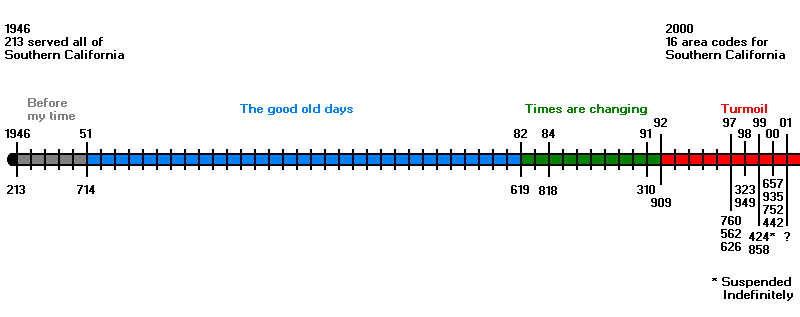
If you live anywhere in the United States except downtown in a major city, chances are your telephone area code has recently changed (in some cases every few years!) or soon will. This is a tremendous inconvenience because all letterhead, business cards, advertisements, and other documents which contain telephone numbers in the affected area must be changed each time this happens.
At one time, in Southern California there were two area codes: 213 for all of Los Angeles county and 714 for all of Orange, Riverside, San Bernardino, and San Diego counties. As of the date of this writing, 213 has spawned 818, 310, 562, 626, and 323 with 424 on the way. Only a small area in downtown Los Angeles today remains in the 213 area code. Parts of what was 714 have become 619, 909, 760, 949, 858, and soon 935, 657, 752, and 442.
Southern California Area Codes 1951-1982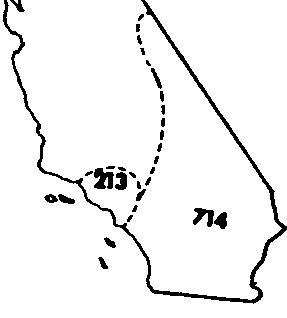
|
Southern California Area Codes 1999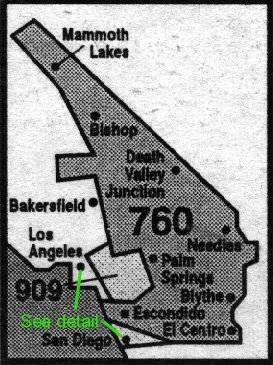
|
Los Angeles 1999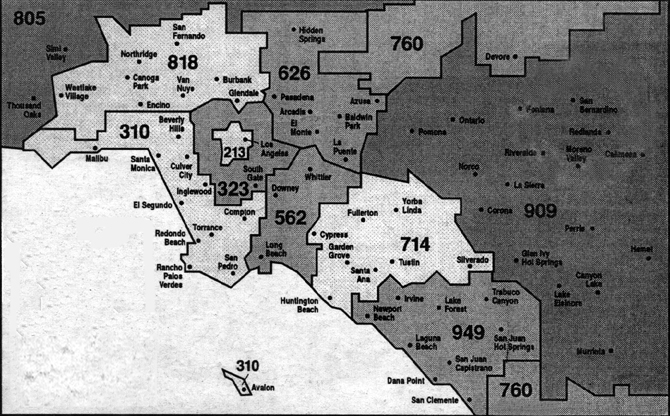
|
San Diego 2000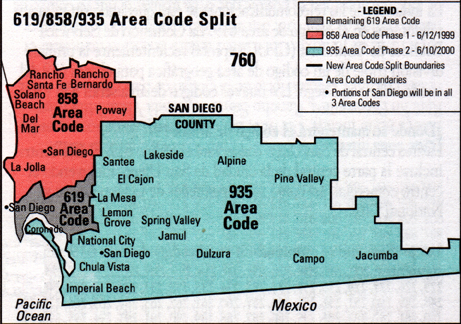
|
Ever wonder why we have to keep splitting our existing area codes into smaller and smaller geographical areas? Doug Hescox, one-time administrator of the North American Numbering Plan, has been continually quoted as saying the phone number shortage stems from consumers' unquenchable thirst for modems, fax machines, pagers, and cell phones, each using its own telephone number. The message that rabid consumerism is causing a number shortage is what the phone companies want conveyed. That certainly contributes to the problem, but it is not the major factor. The truth is that wasteful number assignment and other industry practices account for the biggest part of the problem.
Competitive local phone service and granularity of the routing tables
When you call someone across town or across the country, routing tables get your call from where you
are to where the other person is. The tables indicate what phone company services the telephone
number you are trying to reach and routes your call to that company's facilities. Each telephone
number in the U.S. and Canada is of the form (xxx)yyy-zzzz. (xxx) is the area code and yyy
identifies the serving central office. The problem is that the routing tables only go down to the
(xxx)yyy level. That means that each competing local telephone company must get numbers in blocks
of 104 or 10,000 numbers. Even if a competing local company only
had a few hundred customers, it must take 10,000 numbers for each community it wants to serve out
of the available pool. You can see how with just a few competing phone companies, the number supply
in any area code rapidly depletes. There are estimated to be hundreds of millions of unused North
America Numbering Plan (NANP) phone numbers, but they are being hoarded (companies with multiple
unused blocks are holding on to them "just in case"). Lockheed Martin, the company that is now
the NANP administrator, estimates that only 5% of the numbers allocated are in use. There is
no number shortage other than the one created by these practices.
Industry Lobbying
Also affecting this is the cellular industry's grip on the Federal Communications Commission. FCC
regulations prohibit wireless
services such as cellular phones and pagers from being split off into their own area codes, which
would allow much of the consumer proliferation while leaving landlines undisturbed. Why? Because
the industry doesn't want the experience of calling a wireless phone number to be any different than
that of a landline (by having to dial a special area code), and regulators have a propensity to
kowtow to generous industry lobbyists at the expense of the public they are supposed to protect
from this kind of thing (the numbers are a public resource like the broadcast airwaves).
In California, Assemblymember Wally Knox (D-Los Angeles) has introduced Assembly Bill 818, titled the Consumer Area Code Relief Act. This bill would ensure that retired numbers are reused; require telecommunication service providers to supply information regarding telephone numbers, used and unused, within their possession; and require service providers to return unused blocks of numbers for reassignment to other service providers in need of numbers for their customers. California Assembly Bill 818 by itself can do little to change the practices of an international consortium of telecommunications companies, but it has caused the FCC, which does have the authority, to consider plans that will ease the proliferation of new area codes. The plans would involve overhauling the system to allow telecommunications providers to be issued blocks of 1,000 numbers (instead of 10,000) and to require the providers to show statistics of number assignments before they will be allocated more blocks. The FCC, however, will continue to oppose splitting off wireless devices into their own area codes because such assignments are not "technologically neutral".
Obviously, increasing the granularity of the routing tables, assigning small competitive local phone companies fewer numbers, and splitting wireless devices into their own area codes would go a long way in slowing down the shortage of phone numbers, but I propose going even further.
Currently, area codes are mostly geographic — you get an area code based on where you are. But some areas have overlays, where more than one area code serves the same area. People in overlays always have to dial the full 10 digits — area code and number — whether they are calling within their area code, to another area code in the same area, or outside their area. I propose we take this a step further and abolish area codes, as such, altogether. Everyone gets a 10 digit phone number (you get to keep the one you already have). The first 3 numbers, which used to be the area code, are now meaningless in and of themselves. To call you, everyone in the U.S. and Canada dials the 10 digits which are your phone number, whether the first 3 digits of their phone number match yours or not. This way we get much fuller use of the available number space because phone numbers currently unused in under-populated area codes, like those of Wyoming or Nebraska, could be used by people in densely populated areas like New York City. Also, since everyone always dials all 10 digits — never just 7 — let's do away with dialing 1 first and open up phone numbers of the form 1xx-xxx-xxxx. This alone makes available 1 billion (109) new phone numbers.
We already have the technology to do this. Toll free numbers are non-geographic. We currently have (800), (888), and (877) as toll free area codes. The routing tables for these numbers route on all 10 digits of the phone number. The same could be set up for all phone numbers.


|